
Politicization of the UCSC Humanities
If Dr. King were to visit UCSC
I spent thirty-five years at the University of California, Santa Cruz. It was always highly politicized. Over the decades, the politics intensified and the range of acceptable views narrowed. Disagreeing with the prevailing politics carried social and professional consequences.
My concern is political monoculture. Scholars should be free to pursue Marxist, conservative, liberal, or other arguments and to challenge one another's conclusions. Political agreement should never be a requirement for hiring, promotion, or a voice in university affairs. The same objection would apply to a university dominated by the Right.
I remember sitting on a committee when Professor John Ellis's name came up as a candidate for service on another committee. Members objected strongly because of what they called “his reprehensible politics.” Ellis's Literature Lost criticizes the ascendancy of race, gender, and class politics in literary scholarship.
I saw the same intolerance in hiring and teaching. It undermines the university's obligation to teach students to think independently.
I examined the faculty's published research. The spreadsheet documents research descriptions and publications for faculty listed on the Humanities Division and department rosters. The original inventory contains 264 people. Excluding 76 non-Senate appointments leaves 188 Senate faculty: 115 non-emeritus faculty and 73 emeriti. This main group includes teaching professors and those with the older title of lecturer with security of employment. The excluded group consists of 74 lecturers and two further entries listed under Lecturers and Postdocs. Readers can inspect every classification and source, or use the CSV version to do the arithmetic independently.
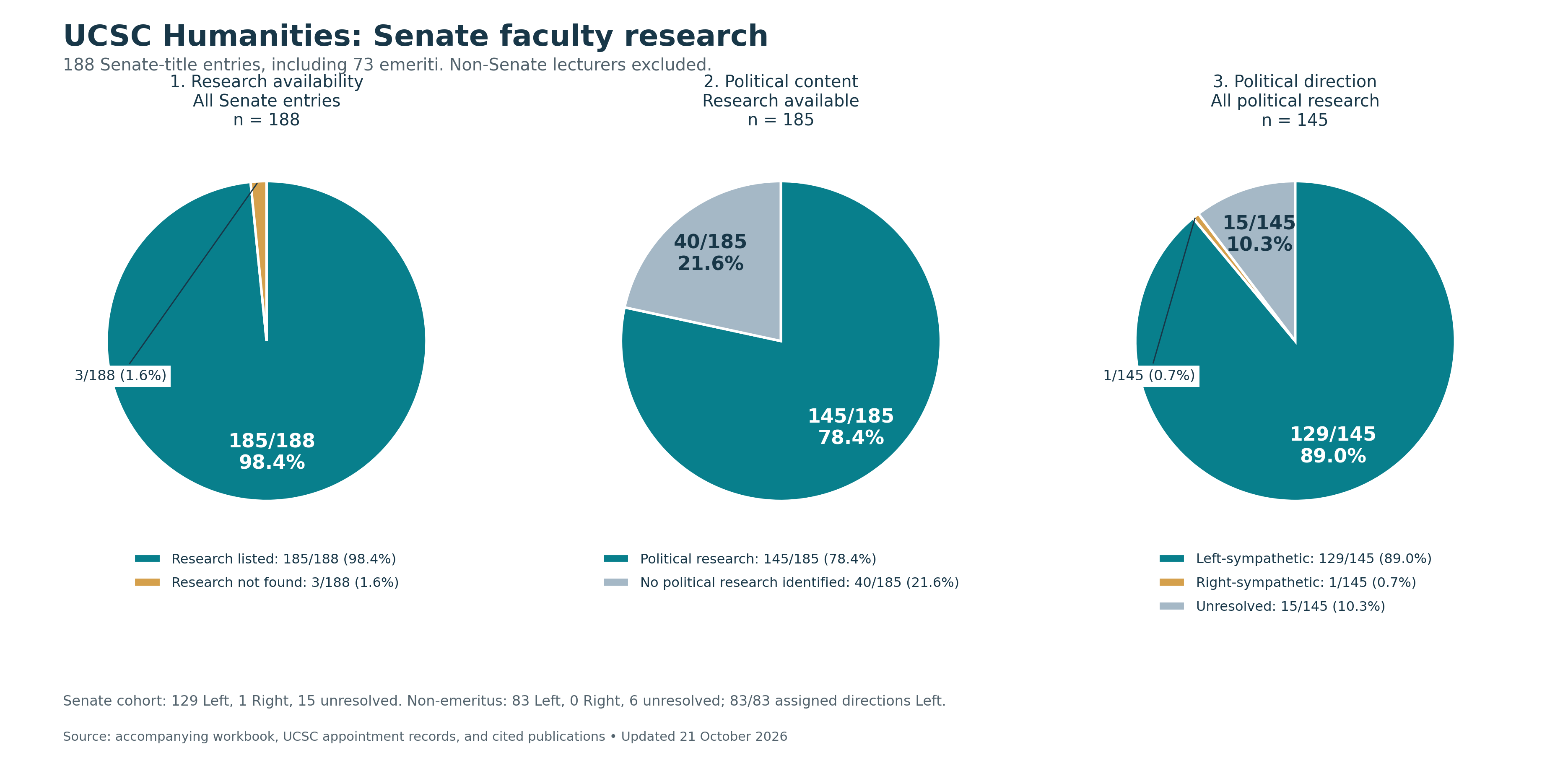
I found research information for 185 of those 188 people; it was unavailable for three, or 1.6%. Of the 185 with research information, 145 (78.4%) had political research, and 40 had no political research identified. Political research includes government, power, law, war, social hierarchy, collective identity, and economic systems.
The table accounts for all 188 people, each counted once:
| Classification of the reviewed research | Non-emeritus | Emeriti | All Senate faculty |
|---|---|---|---|
| Research information unavailable | 1 | 2 | 3 |
| Research available; no political research identified | 25 | 15 | 40 |
| Political research: Left-sympathetic | 83 | 46 | 129 |
| Political research: Right-sympathetic | 0 | 1 | 1 |
| Political research: direction unresolved | 6 | 9 | 15 |
| Total people | 115 | 73 | 188 |
Among the 145 people with political research, the reviewed work was Left-sympathetic in 129 cases (89.0%), Right-sympathetic in one (0.7%), and unresolved in 15 (10.3%). The sole Right-sympathetic entry is John Ellis, an emeritus professor.
The 115 non-emeritus faculty include one without research information, 25 with no political research identified, and 89 with political research. Of those 89, 83 had Left-sympathetic research and six remained unresolved. No Right-sympathetic research was identified in this group.
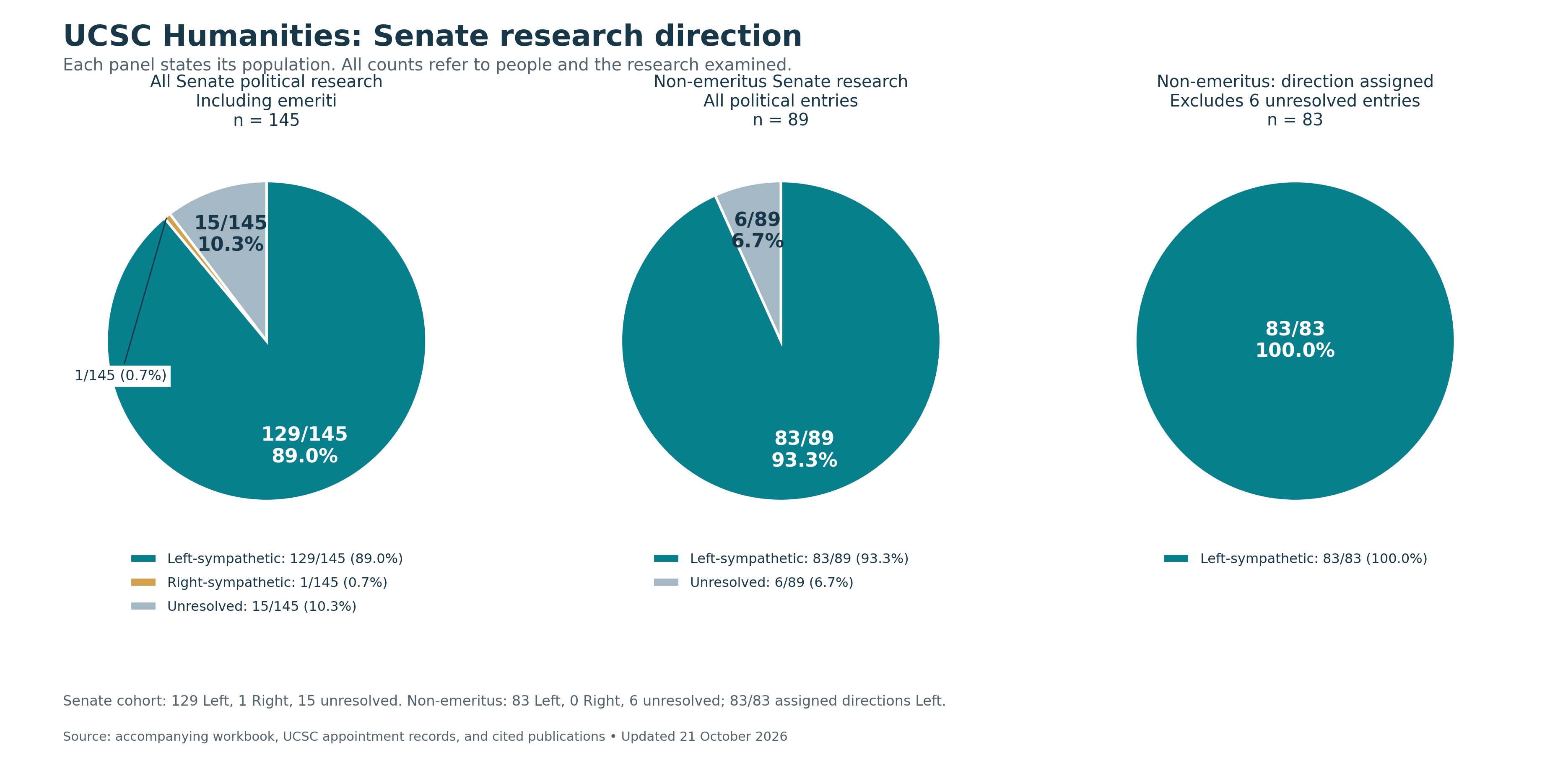
The middle panel includes all 89 non-emeritus political-research cases: 83 Left-sympathetic (93.3%) and 6 unresolved (6.7%). The final panel includes only the 83 with an assigned direction: 83/83, or 100%, Left-sympathetic.
The spreadsheet classifies research arguments using research statements, abstracts, publisher descriptions, and available writings. Left-sympathetic includes progressive and radical positions. Conventional political history counts as political research. Each judgment has an explanation and sources. A separate column links to faculty research statements or interests where available. The figures count people whose reviewed work includes political research; they do not measure what proportion of each person's publications is political. They also do not measure classroom practice or hiring decisions.
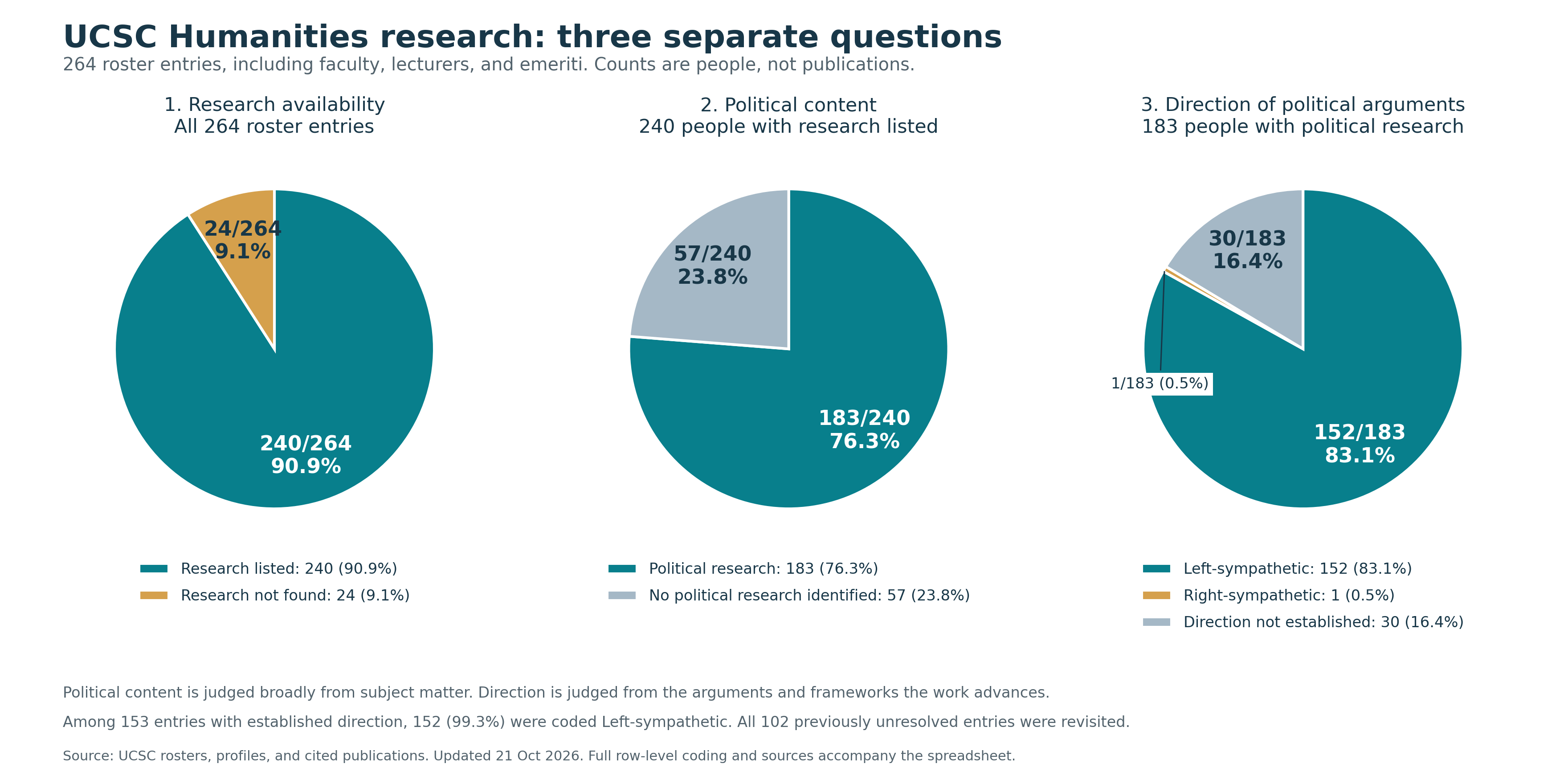
The supplementary analysis of the original 264-person roster, including the excluded non-Senate appointments, is in the workbook and a separate figure.
The departments differ sharply:
| Department or program | Political research / entries with research information | Percentage |
|---|---|---|
| Critical Race and Ethnic Studies | 17 / 17 | 100.0% |
| Feminist Studies | 3 / 3 | 100.0% |
| History of Consciousness | 15 / 15 | 100.0% |
| History | 43 / 44 | 97.7% |
| Literature | 40 / 44 | 90.9% |
| Writing Program | 6 / 8 | 75.0% |
| Philosophy | 9 / 15 | 60.0% |
| Languages and Applied Linguistics | 3 / 8 | 37.5% |
| Linguistics | 1 / 23 | 4.3% |
| Humanities / other units | 8 / 8 | 100.0% |
| Total | 145 / 185 | 78.4% |
These groups cover all 188 Senate faculty, including emeriti; the denominators count the 185 with research information. Cross-listed people are counted once, in the analysis group shown in the spreadsheet. “Humanities / other units” contains entries whose roster information did not support assignment to one of the named groups. The percentages concern political subject matter; the separate direction analysis asks which arguments and frameworks the work favors.
The full Languages and Applied Linguistics roster contains 28 people: 18 non-Senate lecturers excluded from the main analysis and 10 Senate faculty retained. Research information was available for eight of those 10, the denominator in the table. Much of the program's work is practical language instruction. Linguistics is strongly formal, mathematical, and analytical. We used to joke that the linguists belonged in the sciences.
Students studying literature, history, or philosophy should encounter competing interpretations of the subject's central questions. The research reviewed here overwhelmingly favors one side. Parents and students deserve to know that before choosing a program.
UCSC's introductory American history courses HIS 10A and HIS 10B emphasize class, race, ethnicity, and gender in explaining the country's development. The History of Consciousness catalog describes HISC 1 as drawing on radical intellectual traditions. HISC 80W, “What Is Imperialism?”, takes the Marxian concept of imperialism as its starting point. HISC 83 introduces critical whiteness studies. Students should be able to question these approaches and study arguments against them.
At UCSC, I saw America's failures emphasized and its achievements omitted.
Students studying American history should understand the extraordinary achievements of the founding in the context of the eighteenth century. Judge Douglas Ginsburg's A More or Less Perfect Union shows the framers drawing on earlier governments to design a republic that divided power and protected liberty. They reached agreement among states with competing interests. Students should study that achievement.
Our Constitution is the world's longest-surviving written charter of government, and our Declaration of Independence has inspired people around the world to seek freedom and equality. Students should understand what individual liberty, equality before the law, constitutional limits on power, and government by consent have contributed to human freedom.
Judging the founding by twenty-first-century standards obscures what the founders achieved in their own time. Teaching students that America is terrible and irredeemable is political instruction.
A dean explicitly told me that I could not tell my first-generation students, children of immigrants, that in America, if they worked hard, they could achieve anything. I did not grow up wealthy. Hard work and belief that I could achieve a better life allowed me to build one. I was forbidden to speak about that opportunity in my teaching.
Critical Race and Ethnic Studies has acted as a political organization in its own name. AMCHA Initiative's January 2024 report, especially pp. 5–9, documents these actions through departmental statements, announcements, and conference materials:
- A political position adopted in the program's name. CRES's May 2021 statement on Palestine, archived by AMCHA opposes American support for Israel and calls on other academic units to join collective action. It declares, “we reject the language of clashes, conflict, and ‘both sides.’”
- Political agreement as a condition of conference registration. CRES co-sponsored the October 2023 inaugural conference of the Institute for the Critical Study of Zionism. Registration initially required agreement with the institute's political principles, including opposition to Zionism and support for boycott, divestment, and sanctions. A CRES faculty member involved in organizing it confirms in her published account that the organizers removed the requirement at the executive vice chancellor's request. She explains that the principles remained “a starting point for discussion rather than up for debate.”
- A departmental strike announcement. On October 20, 2023, CRES announced on its news page that it was observing a Palestinian-led general strike as a department and would not conduct university business as usual that day.
- An instruction to skip school and work. On November 7, CRES announced departmental participation in the November 9 all-day sit-in at the base of campus, telling readers, “Skip school and work.” The chancellor's subsequent account describes protesters blocking the main entrance for hours, preventing entry and exit, and surrounding drivers who had been waved into the intersection.
- Organizing direct action with students. On November 17, CRES promoted the formation of UCSC's Faculty for Justice in Palestine on its departmental website. AMCHA reproduces that announcement and documents CRES faculty among the group's founders. The group's statement included “collaborating with students on direct action” among its commitments. (Report, pp. 8–9.)
On November 13, UCSC's own provost reminded instructors that university policy prohibits canceling classes to encourage protest attendance and using faculty authority to coerce a student's judgment or conscience.
Faculty have the right to advocate these positions. Students and colleagues have the same right to reject them. Departments should not impose a political position on either group.
Political research is clearly dominant at every rank. The rank comparison covers the 106 non-emeritus regular professors, excluding the nine teaching professors included in the larger group of 115. Political research was identified for 11 of 16 assistant professors (68.8%), 33 of 38 associates (86.8%), and 38 of 52 full professors (73.1%). Associates have the highest share in this inventory.
On hiring committees where I served, political conformity took precedence over scholarly merit. That helped sustain the political monoculture.
The Regents' rule is explicit. Former Standing Order 101.1(d), now Bylaw 40.3(a), states: “No political test shall ever be considered in the appointment and promotion of any faculty member or employee.” The Regents' comparison of the old and new provisions, page 5, confirms that the wording carried over unchanged. I saw that prohibition ignored on hiring committees.
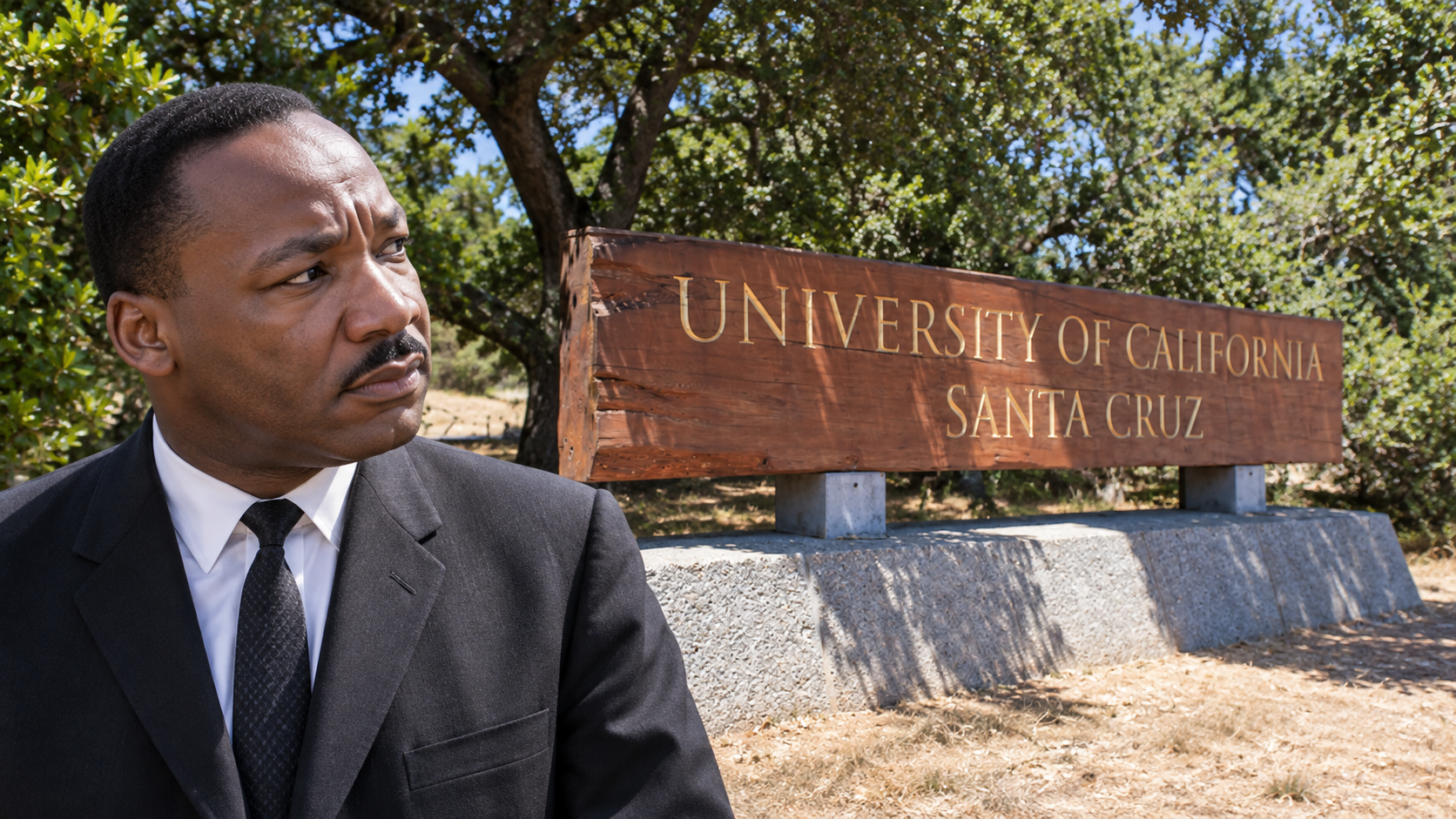
In evaluating DEI statements, I was explicitly told that Dr. Martin Luther King Jr.'s principle that people should be judged by the content of their character was unacceptable. That is right: even Dr. King was no longer acceptable.
At a training session on DEI statements, I asked, “Suppose an elderly friend of mine with a Nobel Prize wanted to apply, but did not know how to write such a statement. Are you saying you would not even look at his CV?” I was told that they would not. A faculty member then yelled, “I would not even want to work with such a racist, and you are a racist for asking this question!”
I was expected to cower. In modern academia, “racist” is about the worst thing one can call a person. I asked, “Are you calling me a racist?” The faculty member immediately backed down.
In December 2021, FIRE challenged UCSC's diversity-statement requirement, documenting how its evaluation rubric penalized applicants who disagreed with the university's positions on diversity, equity, and inclusion. FIRE reported that some searches, including several in engineering and statistics, initially screened applicants on their DEI statements alone. It argued that this procedure excluded dissenters before a full assessment of their academic qualifications and violated freedom of speech and conscience. A diversity statement used as a political test violates the Regents' rule.
In his 1950 pamphlet, The Fundamental Issue, Berkeley historian Ernst H. Kantorowicz challenged the University of California's anti-communist loyalty oath. He was a conservative who explicitly disavowed communism. He opposed making a political declaration a condition of academic employment and warned that accepting one oath opened the way to further demands. As he wrote on page 4, “The harmlessness of the proposed oath is not a protection when a principle is involved.” The Regents dismissed him in August 1950 for refusing to sign.
In his January 4, 1951 letter to J. Robert Oppenheimer, Kantorowicz explained that he was postponing formal acceptance of the Institute for Advanced Study appointment to remain in the lawsuit seeking reinstatement. He joined the Institute later that year. After the courts ordered reinstatement of the nonsigners, he submitted a formal resignation, recorded in the Regents' minutes of December 19, 1952, page 526.
The political screening I witnessed at UCSC amounted to a de facto loyalty oath. While it stood, the mandatory DEI statement made that oath de jure, a formal university requirement enforced through a written evaluation rubric. The political allegiance demanded had changed since Kantorowicz's time. The objection to demanding it as a condition of employment still applies.
On March 19, 2025, the Regents directed UC to eliminate required diversity statements for new hires. The political screening should never have been imposed.
Removing the form does not end the political screening. It just makes it sub rosa, as are most illegal things in the university.
Santa Cruz owes its students an education in which they can encounter opposing arguments, defend their conclusions, and have their work judged on its merits. Faculty deserve the same freedom. The Regents have forbidden political tests. The university should enforce that rule.
On February 20, 2019, my colleague Ethan Miller, a professor in the Baskin School of Engineering, asked the Academic Senate to adopt the University of Chicago's free-speech principles. His resolution in the Senate meeting packet, printed pages 19–20, called on the university to protect open debate even when members of its community found the ideas offensive or wrong.
The Committee on Academic Freedom's written response, printed pages 21–22, argued that existing UC policies made the resolution redundant and that it blurred the distinction between academic freedom and freedom of speech. It also objected to FIRE's politics. It concluded: “Given what appears to be FIRE’s complex political agenda and backing, in our judgment it is not advisable to sign on to a statement that can allow UCSC to appear on a list of FIRE successes on university campuses.”
FIRE is a nonpartisan civil-liberties organization, and its defense of speech crosses political lines. In 2017, before Miller's proposal, it defended a Drexel professor facing investigation over controversial tweets, including criticism of the U.S. military. It later challenged Florida's Stop WOKE Act over restrictions on teaching about race and sex, just as it challenged UCSC's DEI screening. FIRE's presumed politics became another cudgel against Miller. The objections to FIRE did not address the merits of Miller's proposal.
Miller reports in his blog that more than 90% of the faculty voting rejected the resolution. He was pilloried for it, and personal attacks soon followed.