
UCO, Lick, and the UCSC Few People Know
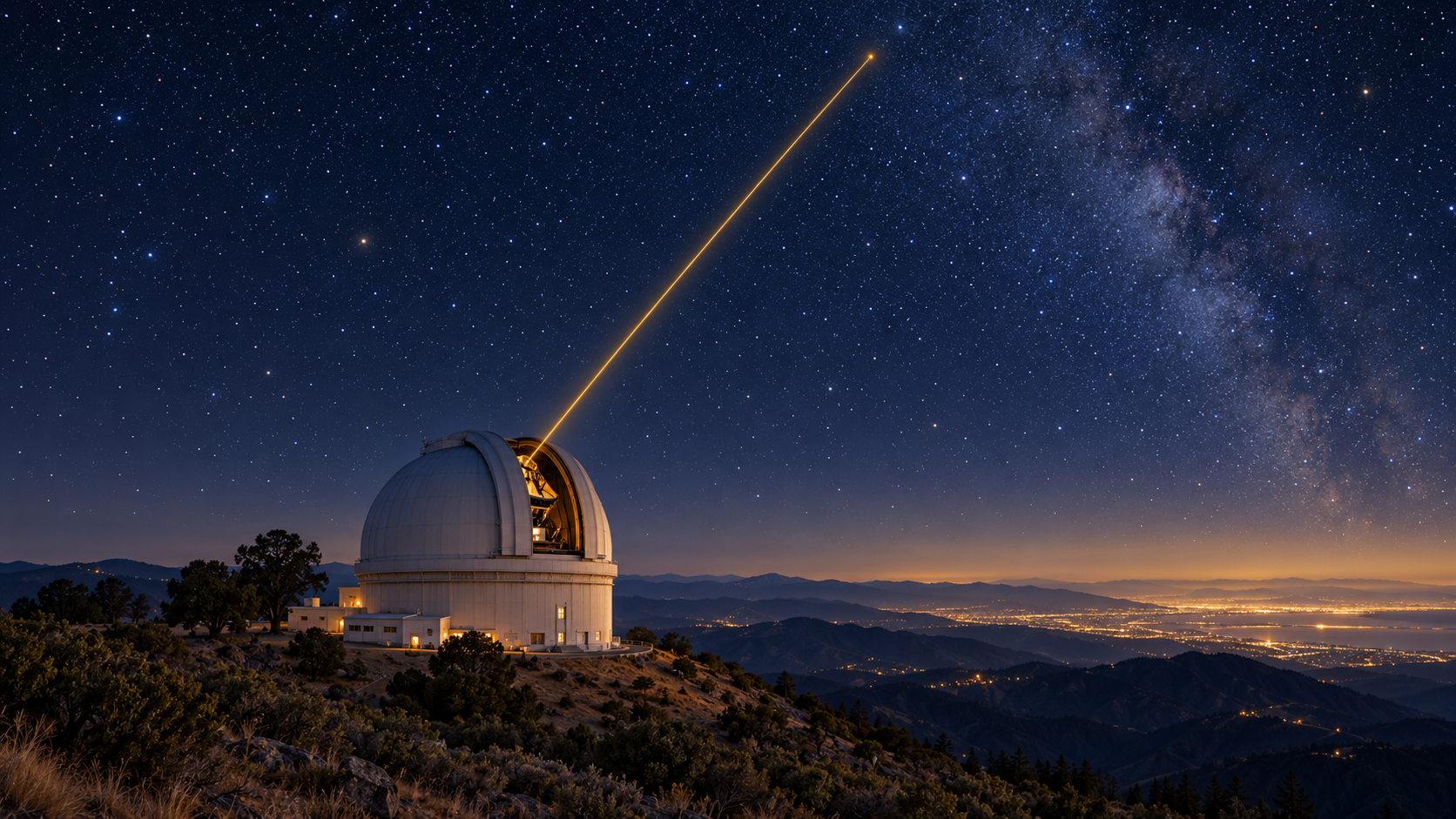
A sodium laser guide star above Mount Hamilton.
UC Santa Cruz is a curious place. Its weakest departments are the ones it celebrates, and the ones that define its reputation. The science is amazing. UCSC is home to the observatory organization serving the whole University of California, yet that responsibility remains largely a secret, on campus and off.
The campus began with a different ambition. Chancellor Dean McHenry's dream was to make UC Santa Cruz the public Oxford. UC San Diego was to be the public Caltech. Brigadier General Harold Hyde, U.S. Army Reserve, retired, was a dear friend of mine. He spoke frequently of Chancellor McHenry and told me about those founding ambitions. General Hyde fought in Patton's Third Army during World War II and retired as a brigadier general in 1983. As UCSC's founding vice chancellor for business and finance under Chancellor McHenry, he helped build the university. His oral history is in the UCSC Library.
These campuses emerged during California's great expansion of public higher education, the era of the 1960 Master Plan. UCSC opened in 1965, as did UC Irvine. UC San Diego was established in 1960 and admitted its first undergraduates in 1964. San Diego's initial ambition was a graduate school of science and engineering comparable in quality to Caltech; its own planning history records that explicitly.
UCSD largely succeeded. UCSC failed to become the public Oxford.
California's legislature did not provide the money needed to sustain the college model and fulfill Chancellor McHenry's dream. Faculty members were expected to serve both their colleges and their academic disciplines. The colleges cost more than Chancellor McHenry had promised, while UC's allocation formula favored graduate students over the undergraduates who dominated Santa Cruz. The university's own oral-history account describes these financial pressures and the subsequent reorganization under Chancellor Robert Sinsheimer, which removed most of the colleges' academic responsibilities.
The colleges still exist. Each retains a freshman “core course,” largely pushing a single world view (1, 2, 3, 4, 5, 6, 7, 8, 9, 10).
UCSD has colleges too, but they work differently. Each has its own character, general education requirements, advising, and residential life. Students can pursue any major from any college. The colleges shape the broader undergraduate experience, while the academic departments provide the major.
Yet UC Santa Cruz developed exceptionally strong science. Particle physics is one example. In a 2007 analysis of research published between 2001 and 2005, UCSC ranked first in physics citation impact among the top 100 federally funded American universities. It had also ranked first among U.S. universities in physics in 2000. Those are measures of how much other scientists use the work. Santa Cruz has repeatedly performed at a level that its public reputation would never lead you to expect.
The University of California Observatories, or UCO, is headquartered at UC Santa Cruz. It operates Lick Observatory on Mount Hamilton and oversees UC's partnership in the W. M. Keck Observatory in Hawaiʻi. The technical laboratories at Santa Cruz and UCLA build the instruments they use.
Lick began operations in 1888, funded by James Lick's bequest of $700,000. It was the world's first permanently occupied mountaintop observatory. The Regents incorporated it into UC Santa Cruz in November 1964; its astronomers and headquarters moved to Santa Cruz in November 1966. The astronomers became the nucleus of the new campus's astronomy department. In 1988, Lick became part of the newly established UCO, as the observatory's strategic history recounts.
General Hyde understood what that meant. In his oral history, he called Lick's arrival “a wonderful jump start in the physical sciences”.
The Hawaiʻi connection is the pair of ten-meter Keck telescopes on Maunakea. Keck is operated through the California Association for Research in Astronomy, with UC and Caltech as its founding partners and NASA joining later. Keck I began scientific observations in 1993, followed by Keck II in 1996. UCO provides the UC side of this major scientific partnership. That is a remarkable responsibility for Santa Cruz to have.
One of the most remarkable advances developed through Lick and Lawrence Livermore National Laboratory is laser guide star adaptive optics.
The atmosphere blurs a telescope's view. Turbulent air bends incoming light by different amounts across the telescope's aperture, and the distortion changes continually. Adaptive optics measures those distortions and uses arrays of computer-controlled actuators to make tiny adjustments at many points across the correcting mirrors, hundreds of times a second. Lick's early system used 127 actuators acting on a continuous mirror surface. The result is a much sharper image. Under suitable conditions, a large ground telescope can produce infrared images that rival or exceed Hubble's resolution at the same wavelengths.
The system needs a reference source bright enough to measure rapidly, close to the direction being observed. Often there is no suitable natural star. The solution is to make one.
A laser is tuned to sodium's D₂ resonance, near 589 nanometers, and aimed into the sky. It excites sodium atoms in a layer roughly 90 kilometers above Earth, making them fluoresce. That small glowing patch becomes the artificial guide star. The golden-yellow color is dictated by the atomic transition: the wavelength must be right to excite the sodium. The returning light allows the adaptive optics system to measure the atmosphere's distortions and correct for them. ESO describes the process here.
Professor Claire Max was central to this work. In the early 1980s, she and colleagues in JASON, the scientific advisory group working on national security problems, developed the sodium laser guide star concept in classified research. William Happer, Gordon MacDonald, Claire Max, and Freeman Dyson eventually published their account in 1994.
The French astronomers Renaud Foy and Antoine Labeyrie independently proposed the approach in 1985. The American work remained classified until 1991. A Livermore technical history records the subsequent experiments: a sodium beacon at Livermore in 1993, followed by the first image improvement using a sodium laser guide star at Lick in 1996. Lick helped turn the idea into a working astronomical instrument.
Professor Richard A. Muller of Berkeley Physics and Lawrence Berkeley Laboratory, a friend of mine for more than twenty-four years, worked on experimental adaptive optics in 1973–1977 and joined JASON in 1973. His CV documents that earlier work.
Prof. Max joined Livermore in 1974. She became an associate director of the NSF-funded Center for Adaptive Optics when it was established at UC Santa Cruz in 1999, joined the UCSC faculty in 2001, and later directed the center. She subsequently became director of UC Observatories. Her work helped change what astronomers could see from the ground.
Why doesn't UC Santa Cruz celebrate this to the same extent that it celebrates social justice and its political identity? I have no idea.
When I told my fellow faculty members that UC Santa Cruz runs the observatory organization for the whole University of California, almost none of those outside the Science Division knew. I cannot recall a student telling me how amazing it was that UCSC had this responsibility.
Almost no one I encounter in Silicon Valley knows it either. Trust me, I know the Valley. Lick stands on the mountain above it, and the university just over the hills has helped build instruments that changed astronomy. That connection ought to be common knowledge.
Instead, people still ask me whether UCSC has grades.
We changed that system in the mid-1990s. I served on the Academic Senate's Committee on Rules, Jurisdiction, and Elections (RJ&E) when we ruled that faculty members could put letter grades in the so-called narrative evaluations. The October 1996 legislative interpretation remains in the Senate manual. Students could request letter grades in almost every course beginning in fall 1997, and conventional letter grading became the default for students entering in fall 2001.
I may write about that silliness another time, including the difficulties it created for our students seeking government employment or jobs at Hewlett-Packard. For now, consider what has endured in the public imagination: the university without grades.
The way the campus governs itself also helps shape its public image. UC Santa Cruz is unusual in having an Academic Senate that operates as a senate of the whole. Every Senate faculty member is a senator, able to participate directly rather than through an elected representative. Consequently, the Senate is dominated by the humanities, social sciences, and arts. Scientists, and now engineers, are busy in their laboratories and focused on experiments. That imbalance in participation helps set the Senate's priorities and the campus's public image.
I will write another time about the decades of campus resistance to Silicon Valley and the School of Engineering. That resistance continues to this day.
The scientists who developed these instruments and built these observatories gave UC Santa Cruz an extraordinary scientific legacy. These observatories serve the whole University of California. Students should arrive knowing about Santa Cruz's responsibility for them and leave proud of it. People in Silicon Valley should know it. The faculty should certainly know it.
I spent thirty-five years at Santa Cruz, and I still do not understand why so many of them do not.