
The University without Grades
An illustration of David Huffman aghast at the silliness.
For decades, UC Santa Cruz was known as the university without grades. People still ask me about it. As I mentioned in my post about Lick Observatory, that reputation has proved more durable than public knowledge of the university's scientific accomplishments.
The idea belonged to a small, personal college where professors knew their students well and could write thoughtful accounts of their work. By the time I was teaching computer science at Santa Cruz, that college had not existed for a long time. We had large classes, quantitative subjects, and students who needed records that graduate schools and employers could understand.
When I arrived at Santa Cruz in 1988, there were no optional letter grades. An instructor was supposed to write a narrative evaluation of each student's performance. The Narrative Evaluation System was completely unsuitable for computer science and the large classes we taught in the sciences.
Our students paid for the experiment. I saw the disadvantages when they applied to graduate school, sought employment with the federal government, or tried to get jobs in Silicon Valley. I remember our students being unable to get hired at Hewlett-Packard because they lacked the grades the company wanted. Loud assurances from defenders of the system in the humanities did not solve those problems.
My colleague Michael Tanner, UCSC's executive vice chancellor from 1992 to 1998, described the same obstacle in his oral history, pages 54–55. He recalled conversations with employers in his field, including IBM and Hewlett-Packard, who had applicants from other excellent universities and little reason to spend time deciphering UCSC narratives. He remembered their question:
Why should we devote some staff time to try to decipher what you're doing here at UCSC?
Some made the effort because they had hired good UCSC students before. That was a favor earned by earlier graduates, not an advantage conferred by our system.
Many students wanted grades. They understood what was at stake.
By then, the supposed alternative to grades had become a code for grades. People were writing Perl scripts to generate evaluations. There was a vocabulary of adjectives corresponding to A, B, C, D, and F. The students knew the vocabulary. Use the wrong adjective and a complaint would arrive at the department chairman's office:
He said that I did “good” in his class, and “good” means “C”!!
We had reinvented grades, with a thesaurus and more paperwork.
I served on the Academic Senate's Committee on Rules, Jurisdiction, and Elections, known as RJ&E. Our chairman was the economist Ronald Grieson. The question before us was whether an instructor could put a sentence like this in a narrative evaluation:
Georgina Spelvin earned a B in this course.
That was the controversy. Could a professor state plainly what everyone was already expressing through a code of adjectives?
We ruled that academic freedom allowed it. The October 1996 interpretations remain in the Senate manual. One established that the Committee on Educational Policy's advisory guidelines were advisory: CEP could not make them compulsory without the approval of the Senate as a whole. Another, specifically concerning the mention of letter grades in narratives, invoked faculty freedom of expression and protected evaluations from substantive changes made without the instructor's approval or the prescribed grievance procedure.
All hell broke loose.
The usual people on the Left who objected to everything did exactly that. The entire campus is on the Left, so I mean the people who would question even Angela Davis's revolutionary bona fides. There were protests and sit-ins. Opponents chained themselves to the doors of the room where the Academic Senate met to discuss grades. Members of RJ&E received threats of violence.
It was glorious.
From 1996 onward, my narrative evaluations gave Miss Spelvin the grade she had earned in the class. I was never asked for a narrative evaluation instead of a grade. Not once in thirty-five years.
Eventually, logic prevailed, though the changes took years. Optional letter grades came after our RJ&E ruling. By fall 1997, students could request letter grades in almost every course, and new undergraduates could accumulate a GPA. In February 2000, the Senate voted to make conventional grading the rule for students entering in fall 2001, with no more than a quarter of their UCSC coursework taken Pass/No Pass. Narratives remained compulsory alongside the grades.
It took another decade to make the narratives optional. On April 23, 2010, the Senate voted 45–5 to leave them to the instructor. Dan Wirls, then chairman of Politics, was one of the five opponents. He called the result “death by voluntarism.” Academic freedom for thee and not for me, I suppose.
UC Santa Cruz operates as a Senate of the Whole. All ladder-rank faculty members are senators, entitled to participate directly. With roughly five hundred senators, those fifty votes represented about ten percent of the body. About ninety percent did not vote. To me, that turnout reflected what most of the campus had thought from the beginning: this was silly.
Santa Cruz now uses conventional letter grading, much like the other UC campuses. Yet the old reputation persists. Reed College is sometimes invoked as the surviving example of a college without grades, but Reed records grades for every class; it simply does not routinely report them to students. It also remains the small, intimate college that Santa Cruz had long since ceased to be.
How silly could the narratives get? My old friend Professor David Huffman, the inventor of Huffman coding, gave me this example from his service on the Committee on Educational Policy. It is an evaluation for fall 1982, dated February 3, 1983. The identifying information is blacked out in the copy he gave me.
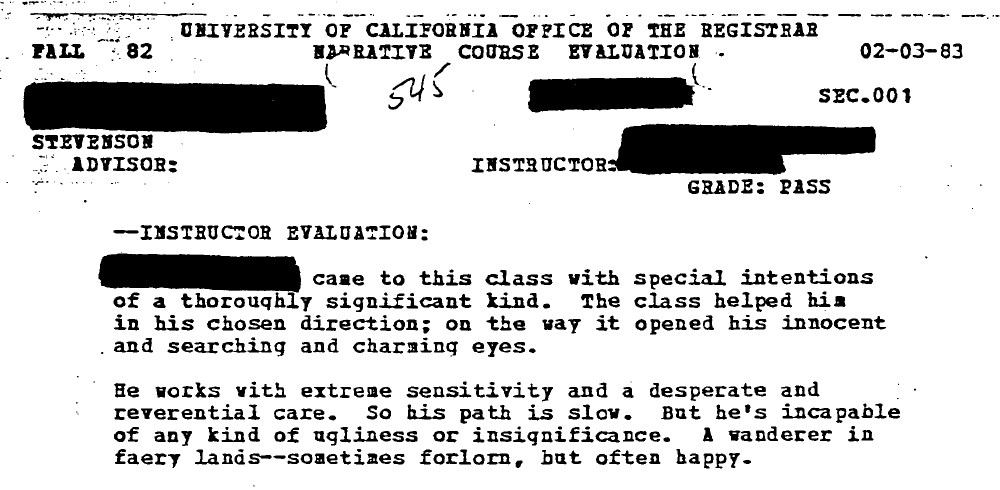
The original scanned evaluation, supplied to me by David Huffman.
[Name redacted] came to this class with special intentions of a thoroughly significant kind. The class helped him in his chosen direction; on the way it opened his innocent and searching and charming eyes.
He works with extreme sensitivity and a desperate and reverential care. So his path is slow. But he's incapable of any kind of ugliness or insignificance. A wanderer in faery lands—sometimes forlorn, but often happy.
The grade was Pass.
What had the student learned? What could he do? How well had he done it? Apparently, he was incapable of ugliness and sometimes happy.
David Huffman knew how to compress information. This was an impressive way of using a great many words to convey almost none.