
It's their fault, and I mean that with love
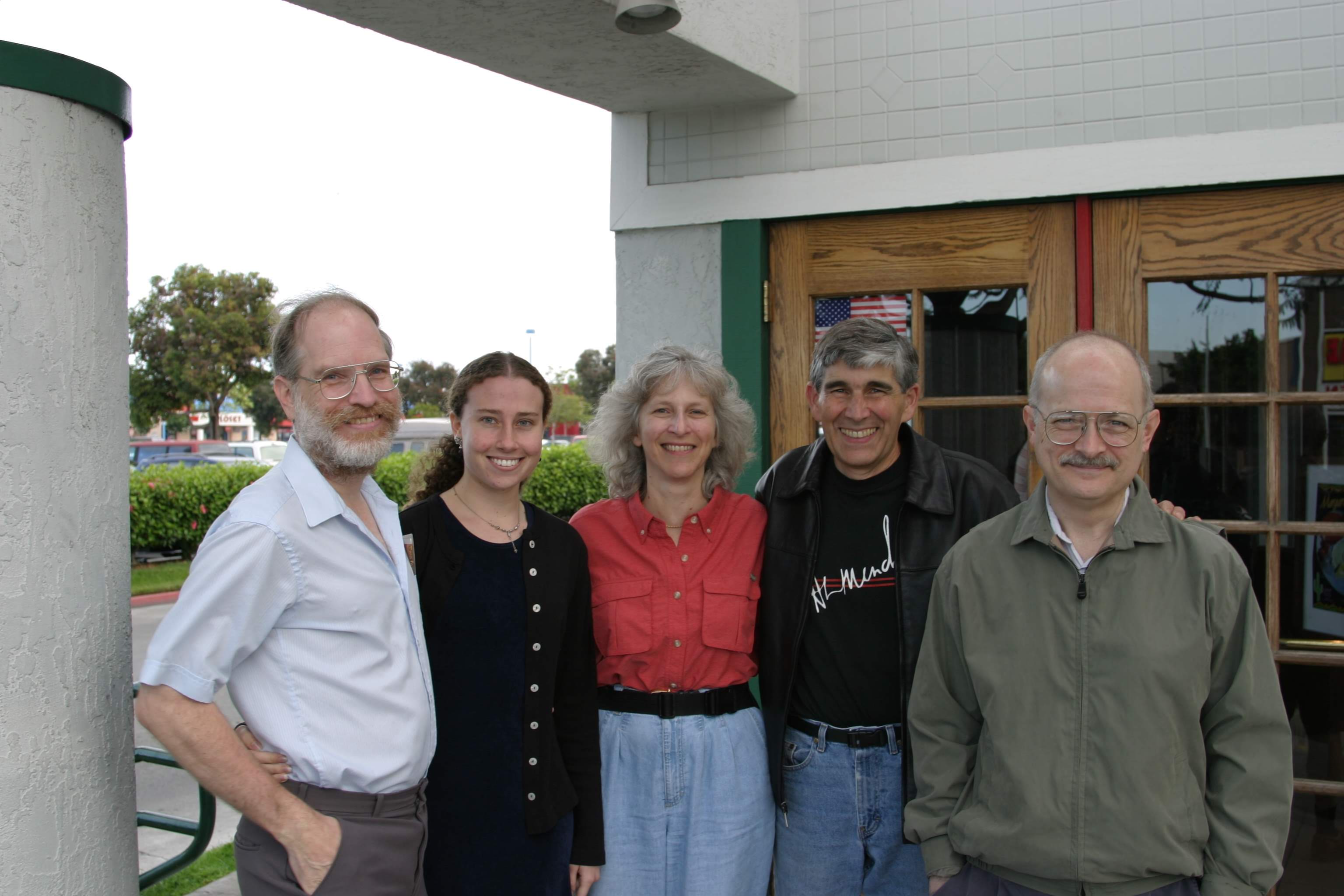
Left to right: John Carroll; his very young wife, Christina; Sara Baase (now Mayers) and her husband, Keith; and Vernor Vinge.
I came to San Diego State straight out of high school. I got in because of my SAT scores, not my grades, but that is another story. I was told recently that even if I had a 4.0, I would not get in today. So much for a Distinguished Professor of Engineering.
My high school grades were not good. My parents had an acrimonious divorce, and I was essentially a Lost Boy. In the summer of 1980, I enrolled in John Carroll's introductory programming class. He taught it in APL. Yes, that language.
I earned the highest score in the class, despite John marking me down for naming my variables BATMAN, ROBIN, and JOKER.
I must have made a good impression, because something amazing happened: John introduced me to Sara Baase and Vernor Vinge. I took PDP-11 assembly language from Vernor. Same result: highest score in the class.
Then the three of them started inviting me, a freshman, to lunch with them every Thursday at Square Pan Pizza.
They were, and remain, my heroes. They taught me how to think.
All three of them formed my views on individual rights and personal liberty. John and Sara had me reading Sowell and Friedman, and Vernor started me with his short story “The Ungoverned.”
Sara taught me politics and philosophy, as well as algorithms. Her classic text, Computer Algorithms: Introduction to Design and Analysis, was first published by Addison-Wesley in 1978.
Vernor would run his latest ideas for the book he was working on past us, and make me question my political assumptions. His novels A Fire Upon the Deep, A Deepness in the Sky, and Rainbows End would all win Hugo Awards.
I remember him asking me what I thought about a race of aliens whose members were individually about as smart as a dog, but could communicate acoustically at one megabit per second (1 Mb/s). Those aliens would become the Tines of A Fire Upon the Deep and its sequel, The Children of the Sky.
John held me to mathematical rigor and, in a fit of insanity, agreed to write a book on automata theory with an undergraduate. That undergraduate was me. The book became Theory of Finite Automata, published by Prentice-Hall in 1989. We have since restored it and prepared a solutions manual.
John and I also brought in the department's first serious grant: a bunch of computers from AT&T, 3B2s and a 3B15.
I had never been told I was good at anything, and now my heroes were telling me I was the best they had ever seen. I lunched with the faculty, had access to any laboratory I wanted, and even had a faculty parking permit for my motorcycle. I was brilliant, I knew it, and I took liberties. I became insufferable, but I was also terrified of letting them down. I had a perfect score in computer science to maintain and their expectations to live up to.
I remember walking into the department chairman's office and declaring that I would not take any more boring lower-division classes. The chairman, Lee Van de Wetering, said, “Alright, smart-ass, from now on it is upper-division and graduate courses for you.”
He thought that would show me. It made me worse.
I can't believe these three, and the rest of the mathematics department, put up with me.
While I was at SDSU, I worked 20 hours a week in the computer center, first as a tutor and later as a system administrator and systems programmer. By my senior year, I was working 40 hours a week there. I also worked weekends at my mother's motorcycle shop.
I got fired twice for being too smart for my own good. The first time, I proved the boss wrong about the VAX. More memory was a better idea than a faster swapping disk, and it was cheaper. The second time, I replaced his code, an incredibly ugly sort in Fortran, with heapsort.
Sara's fault for the heapsort. John's for teaching me queueing theory.
Dr. Kurt Eisemann would see me walking down the hall, all hangdog, and ask what had happened.
“I got fired.”
“What did you do?”
I told him, and showed him the equations. Then, in his German accent: “You are not fired. Go back to work.”
When I was about to graduate, Bill Smith asked me what I planned to do. I had no idea.
“Well, who do you admire most?”
The answer was easy: those three.
What did I need to do to be like them? Get a Ph.D. How did I do that? Go to graduate school. How? Take the GRE.
The GRE was the next week.
When I graduated, I received SDSU's first B.S. in computer science. The opportunity was there, and I had completed the required classes and then some, so I took it. I am sure some strings were pulled, since the degree was not supposed to be available until the following year.
Dean Donald Short appointed me as a lecturer in mathematics straight out of the B.S., before I had even started graduate school. I guess I had him fooled too.
Thankfully, UC San Diego took a chance on a poor boy from El Cajon.
I miss them every day. I regret that I will never see Vernor again. I can never repay my debt to John, Sara, and Vernor, no matter how hard I try.
It's their fault, and I mean that with love.