
Die Like a Scientist, or Scientists Go to Valhalla
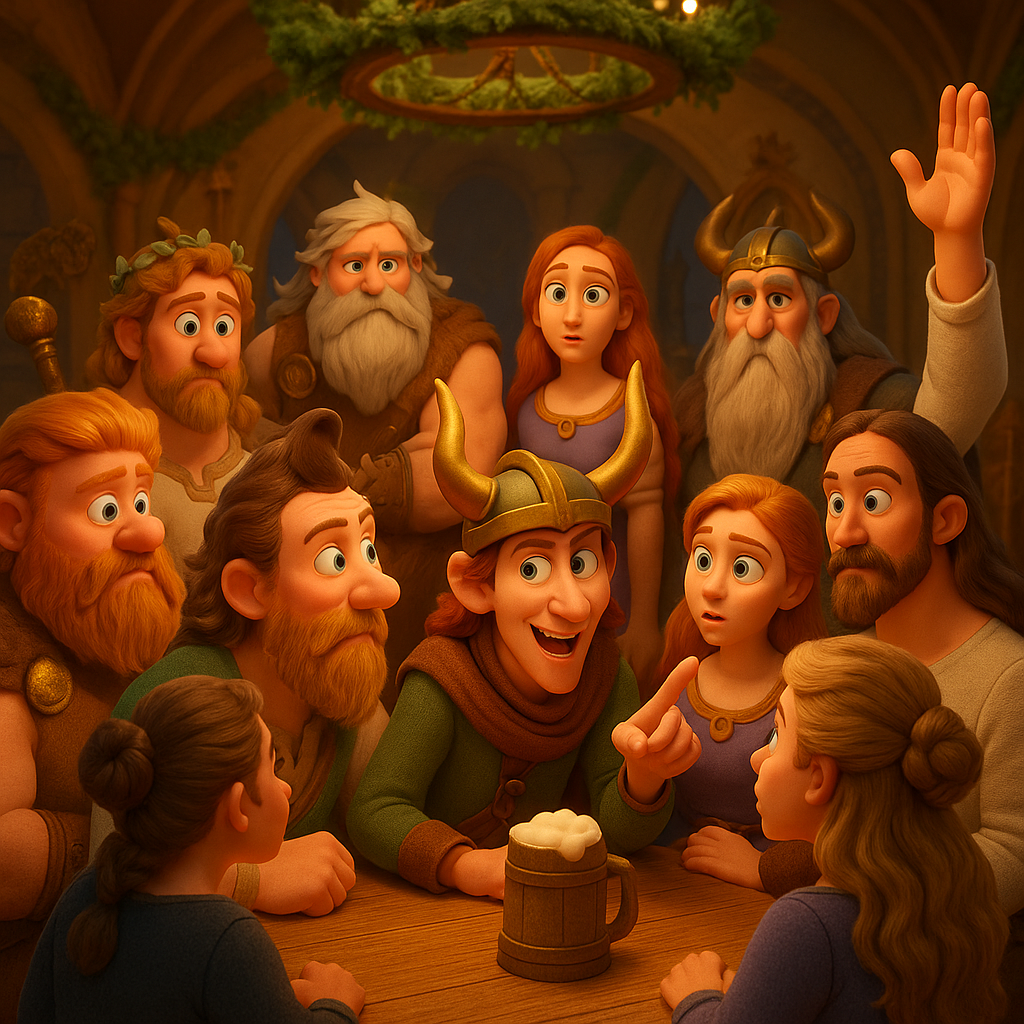
The admissions committee has questions.
A scientist ought to have a place in Valhalla. If a man can earn admission by facing another man with an ax, surely he can earn it by facing an erupting volcano, an Antarctic winter, or a piece of matter whose behavior nobody yet fully understands. There are several ways to stand your ground.
The Norse warrior ideal gives us the starting point. In Snorri Sturluson's Prose Edda, Gylfaginning XX associates Odin's hall with those who fall in battle; chapter XXXIV assigns those who die of sickness or old age to Hel. An uneventful death in bed offers none of the glory of a warrior's death. Snorri, Gylfaginning XX, XXXIV, translated by Arthur Gilchrist Brodeur.
So let us enlarge the admissions policy. Mathematicians, natural philosophers, experimental scientists, and explorers have all faced things that could kill them. Sometimes the danger came from their work; sometimes the world interrupted their work with a sword or a pistol. Here are some candidates for the scientific table.
Pythagoras has the strangest application. In a legend recorded by Diogenes Laërtius, he escaped a burning meeting place, reached a field of beans, and refused to cross it. His pursuers caught and killed him. The beans mattered because of a Pythagorean prohibition. It is an unforgettable picture: a philosopher running for his life who reaches a boundary his convictions will not let him cross. I admire the nerve. I would have further questions about the beans. Diogenes Laërtius, Lives of Eminent Philosophers VIII.34, 39–40.
Archimedes had a much better reason to be difficult. When the Romans took Syracuse in 212 BCE, a soldier killed him. In one of Plutarch's accounts, Archimedes was absorbed in a geometrical problem and refused to accompany the soldier until he had finished the demonstration. In another, he asked for time to complete it before being killed. The old story has survived because every serious mathematician recognizes its priorities. An army has taken the city, a soldier is standing over you, and the proof is still unfinished. Archimedes also designed machines for the city's defense. He had already given the Romans considerable trouble before they reached his diagram. Plutarch, Life of Marcellus 14–19.
Pliny the Elder sailed toward Vesuvius during the eruption of 79 CE. His nephew's account begins with scientific curiosity: an extraordinary cloud deserved a closer look. Then a plea for help arrived, and the investigation became a rescue operation. Pliny commanded the fleet at Misenum and took ships toward the endangered coast, continuing to dictate observations as ash and pumice fell. He reached Stabiae and died during the disaster. His nephew attributed the collapse to breathing difficulties. The essential fact is that he went toward people who needed help while continuing to observe the phenomenon threatening them. Curiosity and duty were aboard the same ship. Pliny the Younger, Letters VI.16.
Tycho Brahe had already lost part of his nose in a duel in 1566, which ought to interest the admissions committee. He survived, wore a replacement, and went on making the extraordinarily precise astronomical observations that would help Kepler work out the motions of the planets. It is widely told that, at a banquet in Prague in 1601, Tycho was too polite to get up and take a piss. He held it in, became desperately ill, and died eleven days later. That is taking table manners much too far. His observations helped change our understanding of the heavens; surely the heavens can accommodate their observer. Odin should give him a seat near the door. NASA on Tycho's observations and Kepler; Aarhus University's account of the duel and his prosthetic nose; the banquet story and contemporary accounts of his illness.
Georg Wilhelm Richmann confronted a force that would have been immediately recognizable to Thor. A physicist at the St. Petersburg Academy of Sciences, he investigated atmospheric electricity and was killed during an experiment in 1753. The discharge that killed him became the subject of a contemporary account published in the Royal Society's Philosophical Transactions. We remember Franklin's electrical experiments; Richmann reminds us that this work could have a different ending. Electricity was becoming something people could measure, and the men doing the measuring were learning how dangerous it could be. If the gods object to a scientist at the table, Richmann can at least say that he met the thunder. St. Petersburg Encyclopaedia; Royal Society account, 1755.
Antoine-Laurent Lavoisier helped build modern chemistry through careful measurement and a new understanding of combustion. The French Revolution sent him to the guillotine on May 8, 1794, after trying and condemning him that morning. His involvement in the Ferme Générale, the private organization that collected taxes for the monarchy, put him among the targets of the Terror; his scientific achievements offered no protection. When I was a professeur invité at Arts et Métiers, I saw the infamous quotation at Lavoisier's exhibit: « La République n’a pas besoin de savants ni de chimistes. » (“The Republic has no need of geniuses or chemists.”) Lagrange's judgment was that cutting off such a head took an instant, while producing another might take a century. Odin can have him. The Republic plainly did not know what it was throwing away. American Chemical Society's biography.
Évariste Galois came closer to the literal entrance requirement. He was wounded in a duel on May 30, 1832, and died the following day, at age twenty. His lasting achievement was mathematics: ideas about equations and their symmetries that became Galois theory. Before the duel, he worked on the mathematical record he would leave behind; one manuscript note says, “I do not have the time.” What moves me is his urgency about preserving it. The duel cost mathematics a life whose possibilities we can scarcely imagine, but his ideas survived him. Galois's Œuvres mathématiques (1846), pp. 408–415 and 423; Paul Dupuy, La vie d'Évariste Galois (1896), p. 250.
Robert Falcon Scott belongs here for something more substantial than coming second in a race. His Terra Nova expedition pursued scientific as well as geographical objectives. During the return from the South Pole, his party collected rocks and fossils, including evidence of vegetation in Antarctica's distant past. They kept hauling the specimens. When the search party found the final camp in November 1912, Scott and his last two companions were dead, and roughly thirty-five pounds of rocks and fossils remained on the sled outside. The specimens included Glossopteris, a fossil plant associated with a much warmer Antarctic past. Men nearing the end of their strength were still carrying evidence home. Scott Polar Research Institute's fossil collection notes; Natural History Museum's Antarctic collection.
Edward Adrian Wilson, who died with Scott in 1912, deserves his own place. A doctor, naturalist, and accomplished artist, he made observations and drawings that still have scientific value. In the Antarctic winter of 1911, he went with Henry Bowers and Apsley Cherry-Garrard to Cape Crozier to collect emperor penguin eggs. Wilson hoped their embryos would illuminate the evolutionary history of birds. Three eggs came back from that punishing journey; the Natural History Museum preserves specimens from the collection. Wilson survived the winter expedition and died on the later return from the pole. His was a life in which going to look meant going out into the Antarctic darkness because the birds would not conveniently breed at a warmer time of year. British Antarctic Survey on the embryological research; Natural History Museum's egg collection.
Roald Amundsen had already won his place in exploration by navigating the Northwest Passage and reaching the South Pole. In June 1928, he joined an attempt to rescue survivors of the wrecked airship Italia. Its commander, Umberto Nobile, had become his bitter rival after their earlier Arctic flight together. Amundsen nevertheless went. The French flying boat carrying him and his companions left Tromsø on June 18 and disappeared; wreckage was later recovered. His expeditions made scientific observations possible. His final journey gives the old warrior virtues a worthy object: someone was in trouble, and an old quarrel could wait. Fram Museum's account of Amundsen's life and last flight.
Alfred Wegener is remembered for continental drift, but he was also a meteorologist and an experienced polar researcher. In 1930, his Greenland expedition established stations to study the ice sheet and weather. When the inland station at Eismitte lacked adequate supplies, Wegener undertook the journey to bring food and fuel himself. He died on the return. His Greenlandic companion, Rasmus Willumsen, buried him and subsequently disappeared; Wegener's grave was found the following spring. The theorist who asked whether continents moved was also the expedition leader who went out to supply his men. His scientific reputation eventually traveled much farther than he did. Alfred Wegener Institute's biography.
Marie Curie earned two Nobel Prizes and spent years investigating radioactivity before its hazards were adequately understood. She carried radium samples in her pockets; Pierre carried a sample in his vest pocket to show his friends. There is something painfully recognizable about that impulse: look what we found. She also helped bring X-ray equipment to wounded soldiers during the First World War. She died in 1934 of aplastic anemia, probably caused by radiation exposure. Any admissions committee that makes room for a man waving an ax can find room for her. Nobel Prize's account of Marie Curie.
Harry Daghlian was twenty-four when a criticality experiment at Los Alamos went wrong on August 21, 1945. A dropped reflector brick caused a plutonium assembly to become critical. He dismantled part of the arrangement to stop the reaction, receiving a lethal radiation dose. He died twenty-five days later. The experiment belonged to the work of understanding the conditions under which a nuclear chain reaction would sustain itself. Daghlian's response to the accident required action in the presence of a danger that had already injured him beyond recovery. National Park Service's account of Harry Daghlian.
Louis Slotin died after an accident with the same plutonium core the following year. On May 21, 1946, a screwdriver slipped during a criticality demonstration, allowing a reflector assembly to close too far. Slotin immediately separated the components and stopped the excursion, but he had received a fatal dose; he died on May 30. This is a difficult story to tell honestly as a heroic death, because his dangerous technique helped cause the emergency. Los Alamos subsequently moved this work to remote operation. Odin should seat him beside Daghlian. Atomic Heritage Foundation's account of the accidents; American Physical Society on Slotin.
David Johnston was monitoring Mount St. Helens when it erupted on May 18, 1980. The thirty-year-old USGS volcanologist was at an observation post considered relatively safe. The enormous lateral blast reached it anyway. His final radio message is remembered as “Vancouver, Vancouver, this is it!” His work had consequences well beyond that last transmission: the USGS credits the monitoring effort with helping authorities restrict access and resist pressure to reopen the area, preventing a much greater loss of life. Johnston understood that evaluating an active volcano required observations made near the thing itself. He was there doing that work. It is difficult to imagine a more direct example of dying at one's scientific post. USGS tribute to Johnston; USGS account of his final transmission.
Karen Wetterhahn studied the toxicity of metals at Dartmouth. In 1996, a small laboratory spill of dimethylmercury penetrated her protective glove; symptoms emerged months later, and she died in June 1997, at age forty-eight. Her own physician, David Nierenberg, remembers that as her condition worsened, she wanted the case discussed so other laboratory workers would learn from it. That request earns her a place here. Faced with a poisoning that medicine could not reverse, she was still thinking about what could be known and who could be helped. Nierenberg's recollections in the American Chemical Society's Tiny Matters.
Sally Ride was brave. A physicist, she flew aboard Challenger twice, becoming the first American woman in space in 1983. She was also a member of JASON, the scientific advisory group. After Challenger was lost in 1986, she helped investigate the disaster as a member of the Rogers Commission. When Columbia was lost in 2003, she served on that investigation board as well. She had entrusted her own life to those machines; after other astronauts died, she helped establish what had gone wrong. Ride died of pancreatic cancer in 2012. Coming home alive had never diminished the courage it took to go, and her service continued long after her last landing. Sally goes to Valhalla too. NASA's account of her flights, investigations, and legacy.
The honor lies in what these people attempted, discovered, preserved, and did for others. Their work gives us a reason to remember their names. The Poetic Edda says it in Hávamál:
Cattle die, and kinsmen die,
And so one dies one's self;
But a noble name will never die,
If good renown one gets.
Hávamál, stanza 77 in Henry Adams Bellows's translation.
That is the scientific Valhalla I have in mind. There should be a long table for people who went out to find something, who took responsibility for the expedition, who kept the observations, who tried to finish the proof. I hope the hall has a blackboard. Galois will need one, and Archimedes will be furious if anybody leans a shield against it.
Be a man. Find work worth doing, and have the courage to do it. Keep your curiosity and your obligations alive for as long as you live. When your time comes, die like a scientist.
As it happens, I have already been to Valhalla. I graduated from Valhalla High School in El Cajon, California, in 1980. I have the diploma to prove it.
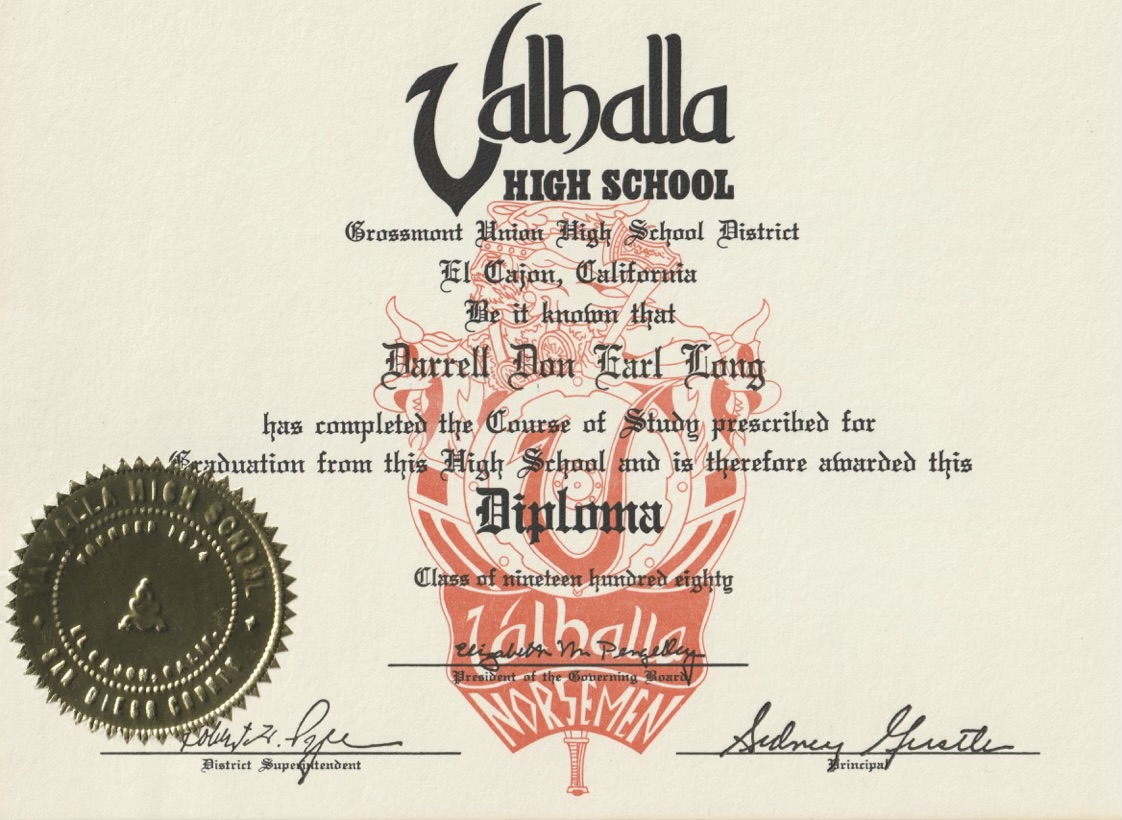
Surely Odin can find a chair for a returning alumnus.