
Why Pentexoire
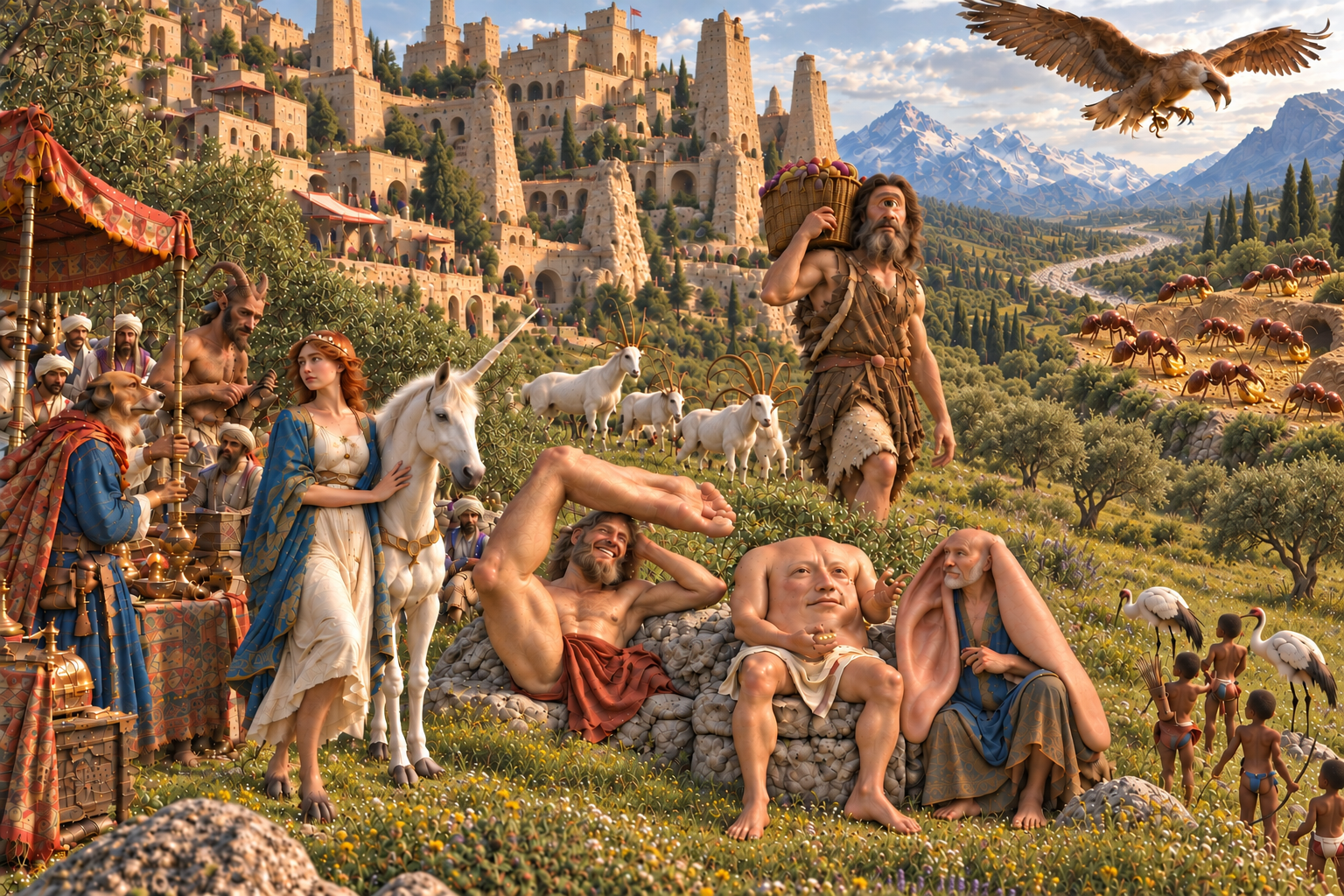
An imagined scene combining creatures from Mandeville and Umberto Eco's Baudolino.
I wanted a single-word domain name. That is difficult. Most recognizable words have already been taken, and adding numbers or inventing a spelling rather defeats the purpose. I found mine in the Middle Ages.
The Travels of Sir John Mandeville is a splendid read, and Umberto Eco's Baudolino is my favorite book. Both concern the land of Prester John, the Christian priest and king whose kingdom lay somewhere beyond Persia in the medieval imagination. Pentexoire is one part of those extensive dominions. At the end of chapter XXIX, Mandeville introduces the name:
And men clepe his realm the isle of Pentexoire.
Clepe means call. But the next chapter opens by describing a much larger domain:
This emperor, Prester John, holds full great land, and hath many full noble cities and good towns in his realm, and many great diverse isles and large.
In this Cotton manuscript version, in modern spelling, Mandeville explains that rivers divide the land into what he calls islands, and that Prester John also possesses islands in the sea. Nyse is the chief city of Pentexoire; later in the chapter, Mistorak is explicitly another island beside it, also under Prester John's rule. Pentexoire belongs to his domain, but does not encompass it. Mandeville gives him seventy-two provinces, each with its own king.
Mandeville's book belongs to the fourteenth century, but the legend of Prester John was already some two centuries old. In 1145, Otto of Freising recorded a story told by Hugh, bishop of Jabala in Syria. Far beyond Persia and Armenia, Hugh said, a Christian ruler named John had defeated the Persian kings. He was both priest and king, descended from the Magi, and had intended to bring his army to the aid of Jerusalem. Unfortunately, he had been unable to cross the Tigris. Otto's account already describes a powerful Christian ally beyond the lands of the crusaders' enemies.
Around 1165, a letter began circulating in Europe purporting to come from this ruler. It was addressed to the Byzantine emperor Manuel I Komnenos. The Letter of Prester John was a forgery. Its author is unknown; its Latin form and political concerns point to a Western European setting, often associated with the German lands. The precise place of composition and the author's purpose remain disputed.
The letter itself is immodest. Seventy-two kings pay tribute to its author. His land possesses extraordinary wealth, fabulous animals, and a river that carries stones instead of water. He promises to lead an immense army to the Holy Sepulchre. He also lectures Manuel on his mortality and questions his religious orthodoxy.
Mandeville gives us plenty to see in those dominions. In chapter XXX, there is a Gravelly Sea, whose sand and gravel rise and fall in waves without any water. Fish live in it nonetheless. A river carries precious stones and great rocks into that sea, also without water. It runs three days each week, when no one dares enter; on the other days it can be crossed. Nearby, trees emerge from the ground at sunrise, grow and bear fruit before noon, then shrink back into the earth by sunset. His palace at Susa has crystal windows, tables of emerald and amethyst, and gems that light the rooms at night.
Then there are the creatures. Mandeville describes horned wild men, man-eating giants, white elephants, unicorns, and dragons. On Taprobane, an island whose king owes allegiance to Prester John, ants as large as dogs guard hills of gold. Getting the gold away from them requires some ingenuity.
Eco puts the medieval bestiary into Baudolino. On the journey toward Prester John's kingdom, the travelers reach Pndapetzim, the city of Deacon John, the priest-king's designated successor. Gavagai is a skiapod, moving on one leg with an enormous foot that also serves as a sunshade. There are headless blemmyae with faces in their torsos, and panotians who wrap themselves in their enormous ears, as well as giants and pygmies.
The inhabitants have plenty to argue about. Their different Christian doctrines matter far more to them than their different bodies: the skiapods are Arians, the blemmyae Adoptionists, and the giants Artotyrites, who use bread and cheese in their Eucharist. The illustration above gathers some of the wonders of these two books, with the river of stones in the distance.
For more on these peoples, John Block Friedman's The Monstrous Races in Medieval Art and Thought is an excellent source. He traces their place in art, literature, and thought from antiquity through the Middle Ages and into the age of exploration.
The wonders help explain why the letter was so widely read. It described a Christian kingdom with fabulous creatures, inexhaustible riches, and an enormous army, and a society without poverty or robbery. A king who read it would think of an ally, a priest of a Christian people beyond the countries he knew, and anyone else of a land where life was better. Beginning in the twelfth century, the story spread through courts and religious houses, and vernacular versions and romances carried it to a wider lay audience, who could hear it told as well as read it.
Even a pope took the distant ruler seriously. On September 27, 1177, Alexander III addressed a letter to John, king of the Indians, and entrusted his physician Philip with a mission to him. Alexander hoped to bring this eastern Christian monarch into closer communion with Rome. We have the pope's letter, although no record of Philip reaching his destination. Or perhaps Philip decided to stay in such a marvelous land.
The central proposition would have comforted a hard-pressed Christian ruler in the twelfth century. Beyond the lands of his enemies was another Christian king, richer and more powerful than any ruler he knew, with an army that could attack those enemies from the other side.
I was recently at Saint-Denis, where the funerary monuments of Clovis and Charles Martel recall the earlier centuries of this history. Clovis, king of the Franks, accepted Catholic Christianity under the influence of his wife Clotilde; his baptism is traditionally dated to 496. Gregory of Tours tells the story, including Clovis's battlefield promise to convert if Christ granted him victory. Charles Martel—Chuck the Hammer—defeated an invading Umayyad army at the Battle of Tours in 732. The rulers who heard of Prester John in the twelfth century had their own wars to fight.
The Seljuk victory at Manzikert in 1071 helped open Byzantine Anatolia to Turkish conquest and settlement. In 1144, Zengi captured Edessa, the first of the crusader states to fall. The expedition launched in response, the Second Crusade, failed.
Pecheneg and Cuman horsemen had attacked the Byzantine frontier from the eastern steppe. The Pechenegs were defeated again in 1122, within the lifetime of men who first heard the Prester John story.
On Europe's northern and eastern frontiers, Christian rulers also fought pagan peoples. In the Wendish Crusade of 1147, Saxon and Danish forces attacked the pagan Slavs along the Baltic, while other crusaders marched toward the Holy Land.
Manuel faced Norman attacks from Sicily as well as rivalry with the German emperor Frederick Barbarossa. His wars and diplomacy also involved Hungary, Serbia, and the crusader principalities. The record of his reign shows how many frontiers he had to defend.
To borrow the largely invented scripture Samuel L. Jackson recites in Pulp Fiction, “The path of the righteous man is beset on all sides.” Those kings were beset on all sides, and here was news of a powerful friend beyond their enemies.
Pentexoire gave me the single-word domain name I wanted, and a connection to two books I love.