
Luigi Dadda (1923–2012)
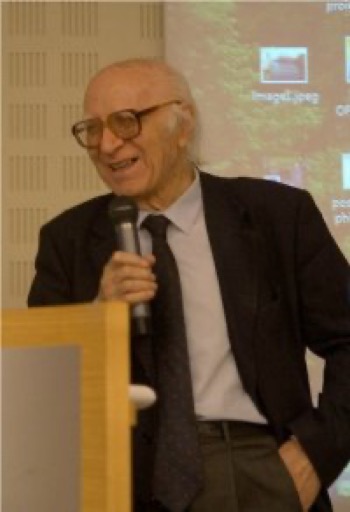
Luigi Dadda spent more than half a century at the Politecnico di Milano, researching computer arithmetic, building its computing facilities, and teaching engineering. His student Domenico Ferrari was the doctoral advisor of my own advisor, Dr. Jehan-François Pâris.
Dadda was born into a farming family in Lodi on April 29, 1923. During the Second World War, he bicycled fifty kilometers to retrieve textbooks after a science bookstore in Milan was bombed. He studied electrical engineering at the Politecnico and completed his laurea in 1947. He remained as an assistant professor under the mentorship of Ercole Bottani.
His early research concerned analog computing. Working with Bottani at the National Research Council, he used electrical networks to model physical systems, including large power networks and magnetic fields described by Laplace's equations.
Marshall Plan funding supported the Politecnico's acquisition of a CRC 102A. In 1954, Dadda traveled to the Computer Research Corporation's plant in the Los Angeles area to work on its construction, according to the department's memorial biography. Installed in Milan that year, the machine gave the university a working digital computer and supported its collaboration with industry.
Dadda trained students and faculty to use the CRC 102A, taught the Politecnico's first institutional course on electronic computers in 1955, and directed the Centro di Calcolo, which served academic and industrial users. With Emanuele Biondi, he designed a floating-point arithmetic unit for the machine. By the late 1950s, he had established a degree program in electronic engineering at the Politecnico.
His best-known contribution to computer arithmetic came in 1965. The Dadda multiplier uses a carefully arranged tree of partial-sum adders to reduce the stages required for parallel binary multiplication. In 2016, the IEEE recognized it as a Milestone in electrical engineering.
His later research included architectures for fast convolution, specialized arithmetic units for CERN's Large Hadron Collider, cryptographic applications, and decimal arithmetic. He studied Petri nets for control-system design, while the Politecnico's computer laboratories expanded into programming languages, databases, and networks.
Dadda became a full professor in 1960 and served as Rector of the Politecnico from 1972 to 1984. His work in professional organizations began earlier: he co-founded the Associazione Italiana per l'Informatica e il Calcolo Automatico in 1961 and served as its president from 1967 to 1970. He also co-founded and edited Rivista di Informatica.
Beyond Italy, Dadda promoted the European Informatics Network, the COST 11 project to link computing centers across Europe. From 1980 to 1982, he chaired the Italian Prime Minister's Science and Technology Committee. He also served on a technical committee and advised the board of CSELT, the Italian telecommunications research center.
He also helped establish the Università della Svizzera italiana in Lugano, where he taught on the university's opening day in October 1996. He founded its Advanced Learning and Research Institute, whose work focused on embedded systems. USI's account of the IEEE Milestone for the Dadda multiplier recalls both contributions.
Dadda was an IEEE Fellow and later a Life Fellow for his contributions to computer arithmetic and digital signal processing. In 1976, he was named Cavaliere di Gran Croce dell'Ordine al Merito della Repubblica Italiana.
His work in California was the first of several California connections in this academic line. Ferrari spent twenty-five years at Berkeley; Dr. Pâris taught at UC San Diego, where I studied with him; and I went on to UC Santa Cruz. The connection between the Politecnico and the University of California extends across four generations.
Luigi Dadda died in Milan on October 26, 2012, at eighty-nine.